
On August 1, 2022, the Center for Judaic, Holocaust, and Peace Studies, in partnership with Appalachian State University’s Department of English and the College of Arts and Sciences, hosted the Rosemary Horowitz z’’l Memorial Conference—a full-day hybrid gathering held on the Boone campus and online. The event honored the life, scholarship, and legacy of Professor Rosemary Horowitz z’’l, the Center’s former director, who passed away in August 2021.
The conference brought together colleagues, collaborators, students, and friends from across the U.S., Canada, Europe, and Israel to celebrate her wide-ranging contributions to Yiddish literature, Holocaust studies, Jewish studies, and English studies.
Remembering Dr. Rosemary Horowitz z’’l
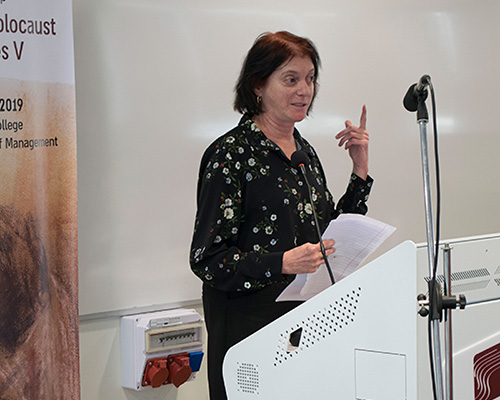
A beloved faculty member at Appalachian State for more than 25 years, Dr. Horowitz was widely respected as a dedicated Holocaust educator, accomplished English professor, patron of the arts, and fierce opponent of antisemitism. The daughter of Holocaust survivors, her scholarship consistently honored their legacy.
Her seminal research began with a groundbreaking dissertation on Yizker (memorial) books, which she dedicated “To the Six Million”—a reflection of her lifelong commitment to Holocaust remembrance and education. Her colleagues noted that her work in Yiddish, Jewish, and Holocaust studies “was ahead of its time,” continuing to influence scholarship worldwide.
Conference Program and Thematic Focus
The all-day conference, held primarily in Belk Library and Information Commons, featured four themed panels, a literary reading, and a keynote lecture.
Panel I – Writing and Reading Holocaust Literature
Speakers explored children’s Holocaust literature, online reader communities, and new perspectives on Elie Wiesel’s work:
- Kathy Kacer – “The Holocaust and Children’s Literature: What Books to Read and How to Pick Them.”
- Madeline Scott – “Online Reader Communities: Young Adult Literature.”
- Prof. Victoria Nesfield – “Reframing Elie Wiesel: Politics, Israel, and the Holocaust Lens.”
Panel II – Voices of Twentieth-Century Jewish Women Writers
This session highlighted influential women’s voices in Yiddish and Holocaust literature:
- Dr. Elvira Groezinger – on Polish-Jewish poet Zuzanna Ginczanka
- Faith Jones – on Yiddish feminist writer Shira Gorshman
- Prof. Boaz Cohen – on survivor Freddzia Student’s testimonies
Panel III – New Research on Yizkor Books
In tribute to Dr. Horowitz’s own field of expertise, scholars presented cutting-edge research on memorial books:
- Prof. Natalia Aleksiun – on Yizkor books as local Holocaust histories
- Prof. Gabriel Finder – on imagery of exhumation and reburial
- Yael Strom – on klezmer music and memorial book culture
- Prof. Hank Greenspan – “Yizker Improvised”
Panel IV – Teaching the Holocaust and Mass Violence
This panel addressed pedagogy, trauma, and ethical classroom practices:
- Prof. Amy Hudnall – “Teaching Trauma in Today’s Trauma-filled World.”
- Prof. Peter Petschauer – on teaching the Karpf family’s Warsaw Ghetto letters
- Prof. Ralph E. Lentz II – on challenges in teaching Nazism and religion
Keynote Lecture: Prof. Eliyana R. Adler
The conference concluded with a keynote by Prof. Eliyana R. Adler (Pennsylvania State University), an award-winning historian of East European Jewry. Her lecture, “Substitute Gravestones: Constructing and Reconstructing Holocaust Memorial Books,” examined how Jewish survivors shifted from attempting to build physical memorials in postwar Poland to creating literary memorials in Yizker books.
Adler demonstrated how these texts blended memory, mourning, and community rebuilding—core themes central to Dr. Horowitz’s scholarship.
Honoring Her Legacy
In conjunction with the memorial conference, the Center announced plans to establish the Annual Rosemary Horowitz Memorial Lecture in Israel, Yiddish, Jewish, and Holocaust Studies. A joint committee of Appalachian State University faculty and members of the Temple of the High Country—where Dr. Horowitz was an active participant—will select future speakers.
This endowed lecture will ensure that Dr. Horowitz’s scholarship, passion for teaching, and commitment to preserving Jewish memory continue to shape future generations.